Making Sense: From Attention to Action


Introduction
The landscape of Artificial Intelligence is currently undergoing a "Cambrian Explosion." Every week, new models, frameworks, and specialized tools emerge, leaving developers and enterprise leaders asking the same question: How do all these pieces fit together?
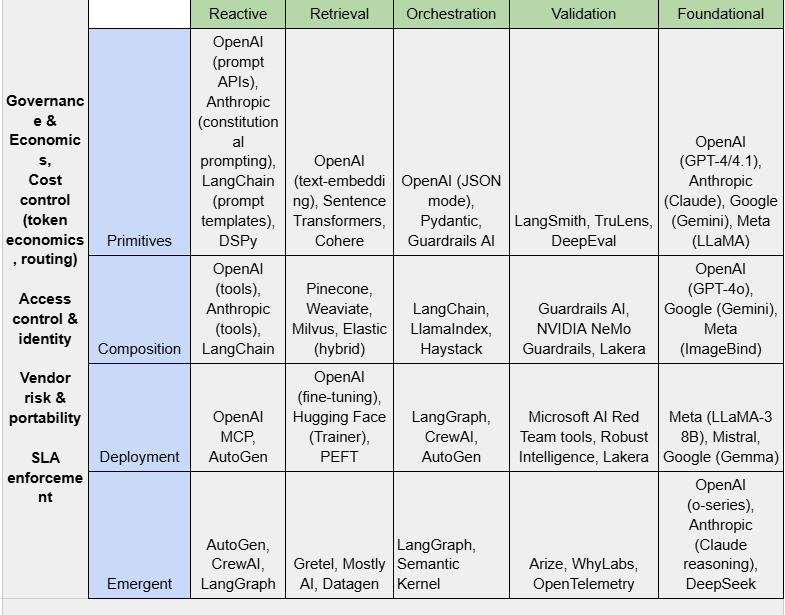
To navigate this complexity, we need more than just a list of tools; we need a mental model. Inspired by the foundational structure of chemistry, we can view the modern AI ecosystem as a Periodic Table of the AI Stack. This framework categorizes the "elements" of AI—from the raw power of Large Language Models (LLMs) to the intricate orchestration of multi-agent systems—into a cohesive map.

Let’s break down the AI Stack into its core components: the functional columns, the evolutionary rows, and the critical governance layer that holds it all together.
The Foundational Pillar: Governance & Economics
Before we dive into the "active" elements, we must address the foundation. In our Periodic Table, Governance & Economics isn't just a single cell; it’s a pillar that intersects every layer of the stack.
As AI moves from experimental "playgrounds" to production environments, these four areas become non-negotiable:
Cost Control: Managing token economics and implementing intelligent routing to balance performance with budget.
Access Control & Identity: Ensuring that only authorized users and processes can interact with specific models and data.
Vendor Risk & Portability: Avoiding "vendor lock-in" by building systems that can transition between providers like OpenAI, Anthropic, or Google.
SLA Enforcement: Monitoring uptime and performance to ensure AI services meet enterprise-grade reliability.
Without this pillar, the rest of the stack is merely a collection of expensive experiments.
The Horizontal Rows: The Evolutionary Layers
The AI stack is organized into four horizontal rows, representing the progression from basic building blocks to complex, autonomous systems.
Primitives: The Atomic Units
These are the basic inputs and outputs. In the Reactive column, we have Prompt Engineering (using tools like LangChain or DSPy). In Retrieval, we find Embeddings (OpenAI, Cohere). The Orchestration layer at this level focuses on Control Tokens and structured outputs (JSON schema enforcement via Pydantic). Finally, the Foundational element here is the LLM itself—the GPT-4s and Claudes of the world.
Composition: Building the Molecule
Once you have the atoms, you begin to compose them. This layer introduces Function Calling and Tool APIs, allowing models to interact with the outside world. We see the rise of Vector Databases (Pinecone, Weaviate) for hybrid search and RAG Frameworks (LlamaIndex, Haystack) to give models context. Safety also moves up a notch with Guardrails (NVIDIA NeMo) to constrain outputs.
Deployment: Productionizing the Stack
This is where AI becomes "software." We move into API Gateways and Fine-tuning (using LoRA or QLoRA). AI Frameworks like CrewAI and AutoGen begin to manage more complex workflows. On the validation side, we see Red-teaming and continuous evaluation pipelines to detect drift. Interestingly, this layer also highlights Small Language Models (Mistral, Gemma), which offer efficiency for specific tasks.
Emergent: The Future Frontier
The top of the table represents the cutting edge. Here, we find Multi-Agent Systems with self-reflection loops and Synthetic Data generation (Gretel, Datagen). The orchestration evolves into Autonomous Planning and long-horizon task execution. The most advanced foundational elements here are Thinking Models (like the OpenAI o-series or DeepSeek), which prioritize reasoning over simple pattern matching.
The Functional Columns: The Groups of the Stack
Just as the columns in a periodic table group elements with similar properties, our AI stack is grouped by function.
Reactive: This column is about the interface—how we talk to the AI and how it talks back. It spans from simple prompts to complex multi-agent interactions.
Retrieval: This is the "memory" of the stack. It involves turning data into embeddings, storing them in vector databases, and fine-tuning models on proprietary datasets.
Orchestration: The "brain" of the operation. It manages the logic, from JSON enforcement to RAG frameworks and autonomous goal decomposition.
Validation: The "safety and quality" department. It includes everything from BLEU/ROUGE metrics to causal probes and regulatory audit logs.
Foundational: The "engine." This column tracks the evolution of the models themselves, from general LLMs to multimodal and reasoning-heavy models.
Case Study: Adept and the Rise of "Digital Workers"
To see this periodic table in action, look at Adept, a startup that perfectly illustrates the intersection of these elements. Adept isn't just building a chatbot; they are building an Agent-as-Software platform.
Adept’s stack utilizes several "elements" from our table:
Foundational Primitives: They use models like Fuyu-8B, a multimodal model designed for digital tasks.
Retrieval & Composition: They’ve developed Action-oriented tokens and a proprietary Action Vocabulary (AWL). This allows their agents to turn a "tool call" into a deterministic interaction with a UI or an enterprise API.
Orchestration & Emergent: Their system can execute multi-step plans, persist state, and adapt based on intermediate outcomes—moving them firmly into the Autonomous Planning category.

Foundational-primitives | Fuyu-8B & Fuyu-Medium |
Retrieval-composition | Action-oriented tokens in proprietary multi-modal embedding, AWL |
USP: AWL | Deterministic tool/action invocation. Structured interaction with UIs, APIs of enterprise software products |
Reactive-Deployment | Long-running automations, Cross-application execution and workflow |
Orchestration-Composition | Encodes sequences of actions, Supports conditional branching and Represents task structure, not just tool calls |
Orchestration-Emergent | Execute multi-step plans, Persist state and Adapt based on intermediate outcomes |
Adept represents a shift from AI that "writes" to AI that "does," turning plugins and skills into enterprise-grade digital workers that can operate across desktop and web apps.
Case Study: Customized Investment Platform developed by me
Here is the dependency mapping for multi-agent investment research platform, based on the AI periodic table, outlined in the document.
Platform Dependencies Table
Platform Component | AI Stack Category | Recommended Dependency |
Multi-Agent Orchestration | Emergent / Deployment | LangGraph, CrewAI |
Foundational Reasoning | Foundational | Gemma, Gemini, Anthropic (Claude) |
Agentic Memory (RAG) | Retrieval | Pinecone, Weaviate |
Tool Calling & Prompts | Reactive | LangChain, OpenAI (tools) |
Evaluation & Safety | Validation | LangSmith, Guardrails AI |
To build the multi-agent investment research platform, we select dependencies across the AI stack's evolutionary layers. I use LangGraph and CrewAI for emergent orchestration, Pinecone for compositional retrieval, and Gemini and Anthropic models for structured extraction and foundational reasoning, respectively. Reliability is enforced using validation tools like LangSmith and Guardrails AI.
Navigating the Elements
The beauty of the Periodic Table of the AI Stack is that it allows you to see where your current projects sit and where the gaps might be. Are you focusing too much on the Foundational engine while ignoring the Validation and Governance layers? Are you stuck in the Primitives row when your business needs the Composition of RAG and Function Calling?
As the industry moves toward "Thinking Models" and "Autonomous Agents," the complexity will only increase. By categorizing these tools into a structured stack, we can move away from the hype and toward building robust, scalable, and governed AI systems.
Whether you are a developer choosing between Pinecone and Milvus, or a CTO deciding on a multi-agent strategy with LangGraph, remember that every element has its place. The goal isn't to use every "element" on the table, but to combine the right ones to create the "chemistry" your business needs.


Comments